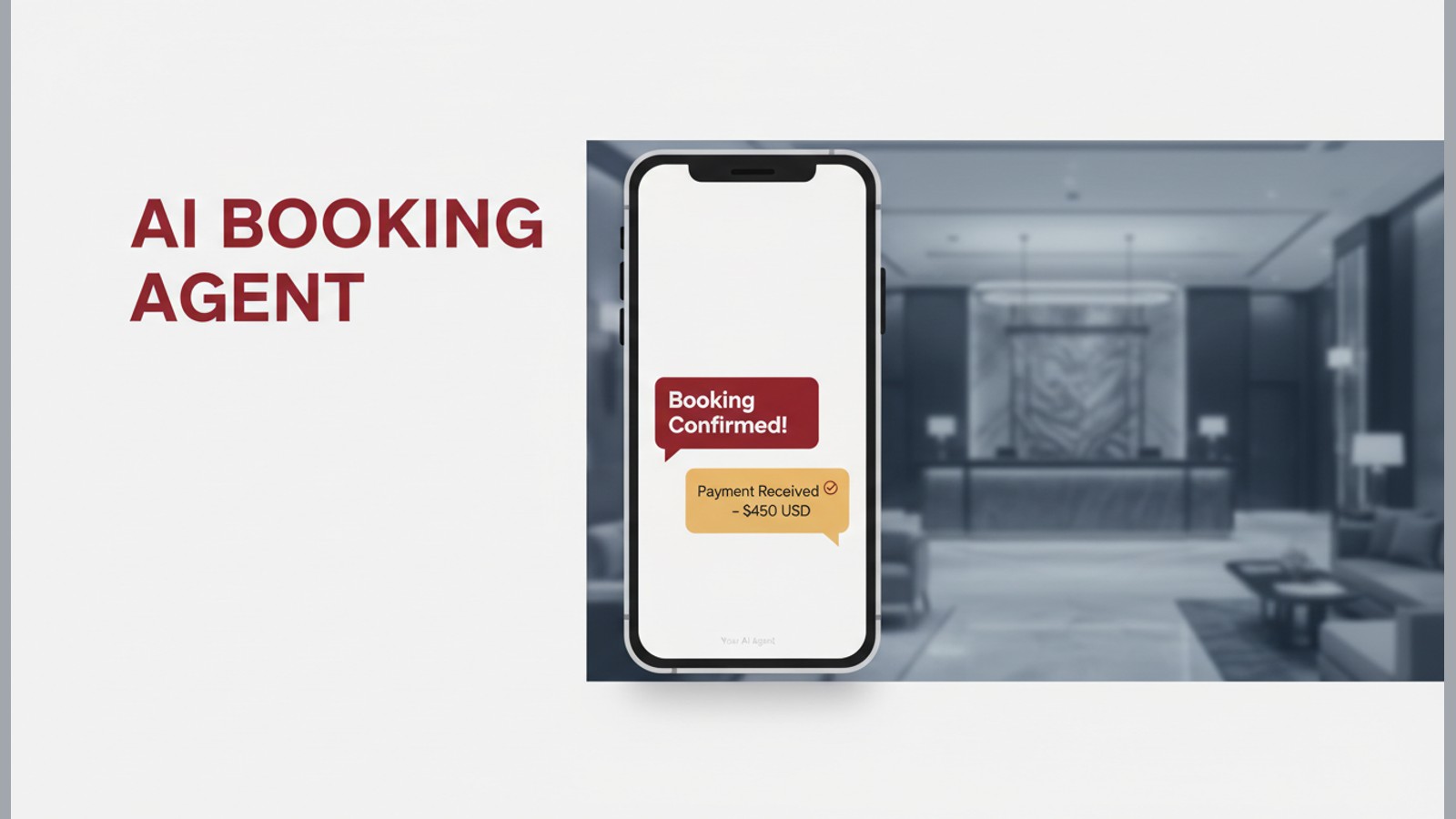
The Reply Bot Trap
Your hotel website probably has a chatbot. It answers questions about check-in times, pool hours, and pet policies. Then it dumps the guest onto a booking engine with 12 form fields and a credit card page that loads in a new tab.
That guest has a 60% chance of never returning.
This is the reply bot problem. Most hospitality AI stops at conversation. It does not complete transactions. It does not verify inventory. It does not handle payment. The handoff to human staff or external booking engines creates friction, and friction kills conversion.
Agentic AI closes this gap. These systems do not just respond. They act. They query live property management systems (PMS), confirm actual room availability, quote accurate rates including taxes and fees, complete reservations with inline payment capture, and trigger post-booking workflows like confirmation emails and calendar holds.
Agentic AI defined: Autonomous software agents that perceive their environment, make decisions, and take actions to achieve specific goals without constant human oversight. In hospitality, the goal is simple: convert inquiry to confirmed booking with zero staff intervention.
Why Live PMS Integration Changes Everything
Static chatbots rely on cached rate tables and room inventories updated nightly. This creates two expensive failures: double bookings and phantom availability.
A guest asks about a king suite for Friday night. The bot checks yesterday's data. The room shows available. The guest proceeds, enters payment details, and receives a confirmation. Meanwhile, another guest booked that same room through the hotel's direct booking engine 20 minutes ago. Now your front desk spends Monday morning explaining, apologizing, and rebooking at a discounted rate to preserve the relationship.
Agentic systems connect directly to PMS APIs in real time. When a guest requests dates, the agent queries actual inventory, applies current rate codes, checks minimum stay requirements, and validates promotional restrictions before presenting any option. The confirmation happens only after server-side verification locks the inventory.
Platforms like Qontaktly operate this way by default. The agent does not guess. It knows.
The Integration Stack
| Component | Function | Failure Mode Without It |
|---|---|---|
| PMS API connection | Live inventory, rates, restrictions | Double bookings, rate errors |
| Channel manager sync | Cross-platform availability | Overbooking from OTAs |
| Payment processor | Tokenized card capture | Abandoned carts, fraud exposure |
| CRM linkage | Guest history, preferences | Missed personalization, loyalty gaps |
Payment Mechanics: Friction vs. Security
The final conversion step matters most. Traditional chatbots hand guests a booking engine link. Agentic AI handles payment inside the conversation thread. Two architectures dominate, with meaningful tradeoffs.
Inline card capture uses tokenization services like Stripe Elements or similar providers embedded directly in the chat interface. The guest enters card details without leaving the conversation. The agent receives only a payment token, never raw card data. Completion rates run 35-50% higher than redirect methods because the guest never loses context or momentum.
Secure link follow-up sends the guest a single-use, time-limited payment URL via the same channel (WhatsApp, Messenger, web chat). This adds one tap but keeps sensitive entry on the processor's hosted page. Some properties prefer this for perceived security, though abandonment increases 15-20%.
Channel constraints matter. WhatsApp supports rich in-app payments in some markets. Instagram and Facebook Messenger offer native checkout flows. Web chat enables full embedding. Smart agents adapt to each channel's capabilities rather than forcing one method everywhere.
PCI compliance reality: Neither approach makes your hotel PCI-compliant by default. Tokenized inline capture reduces scope significantly, but you still need proper agreements, security questionnaires, and annual assessments. Treat payment-in-thread as a technical capability, not a compliance shortcut.
Revenue Engineering: Upsells That Actually Sell
The best time to sell an airport transfer is right after the guest commits to the room but before they close the conversation. Their credit card is already out. The booking momentum is live. The agent has their dates, party size, and arrival time.
Agentic AI captures this moment with contextual offers:
- Room upgrades: "For ₹2,400 more per night, I can move you to a corner suite with a river view. Confirm?"
- Early check-in / late checkout: "Your flight arrives at 6 AM. Add early check-in for ₹1,800?"
- Experiences: "The spa has availability Saturday evening. Shall I reserve your couple's massage?"
- Dining: "Our rooftop restaurant books 48 hours ahead. I can hold a table for your first night."
These are not generic popups. They are personalized, timed, and actionable within the same thread. Properties using agentic upsells report attach rates 3-4x higher than pre-arrival email campaigns. The difference is timing and effort: one tap versus a separate login, form, and checkout flow.
For independent hotels in competitive markets like Goa or Jaipur, this direct revenue matters enormously. Every booking captured without OTA commission preserves 15-25% of room revenue. Every upsell attached increases average guest spend without increasing acquisition cost.
Safety Architecture: Trust at Scale
Autonomous booking agents require robust guardrails. A system that can charge cards and modify reservations needs limits. The safety architecture has four layers.
Server-side rate verification: The agent never trusts its own calculations. Before finalizing any transaction, it re-queries the PMS for current rates, confirms the total matches what was quoted, and validates that no restrictions have changed since the conversation began.
Hard spend caps: Per-transaction and daily limits prevent runaway charges. A single booking cannot exceed a configured maximum. A single guest interaction cannot process multiple transactions above a threshold without human escalation.
Audit logging: Every query, quote, and confirmation is logged with timestamps, PMS response codes, and payment tokens. Dispute resolution and revenue auditing become straightforward. Pattern analysis identifies unusual agent behavior before it becomes costly.
Escalation protocols: Complex requests, rate mismatches, system timeouts, and guest frustration signals trigger immediate handoff to human staff. The agent does not guess through ambiguity. It escalates with full context preserved.
ElevAIte perspective: We see too many hospitality AI projects fail on implementation, not concept. The technology works. The integration fails. PMS APIs vary enormously in capability and documentation. Payment processors have conflicting requirements by market. Build your safety architecture before your first guest conversation, not after your first incident.
From Operational Cost to Revenue Driver
Reframe the chatbot conversation. Most hotels view AI as a way to reduce front desk calls. This is defensive thinking. The real opportunity is offensive: capturing bookings that would otherwise go to OTAs or competitors.
A guest browsing at 11 PM finds your property on Instagram. They message your account. An agentic system responds instantly with availability, photos, reviews, and a complete booking path. The reservation is confirmed before your night manager even sees the notification. The guest receives confirmation, calendar invite, and local recommendations. The OTA never enters the picture.
This is not theoretical. Platforms like Alveni AI and Opally operate this way today across website, WhatsApp, and social channels. The shift from FAQ tool to booking engine is architectural, not cosmetic. It requires live data connections, payment infrastructure, and safety systems. The result is measurable revenue impact, not incremental efficiency.
Implementation Priorities
Hotels evaluating agentic AI should sequence their rollout around conversion impact:
- PMS integration first. Without live inventory, you have an expensive FAQ bot. Verify your PMS has modern APIs and documentation.
- Payment infrastructure second. Choose your processor, complete compliance review, and test tokenized capture across target channels.
- Upsell logic third. Define your attachable services, pricing rules, and presentation triggers before going live.
- Safety systems always. Implement caps, logging, and escalation before the first production transaction.
The gap between reply bots and booking agents is widening. Guests expect instant, accurate, complete service. Properties that deliver it capture direct bookings at lower cost. Those that hand off to forms and phone queues lose to competitors and intermediaries.
Agentic AI is not the future of hospitality technology. For leading properties, it is the present.
Sources
Share this article