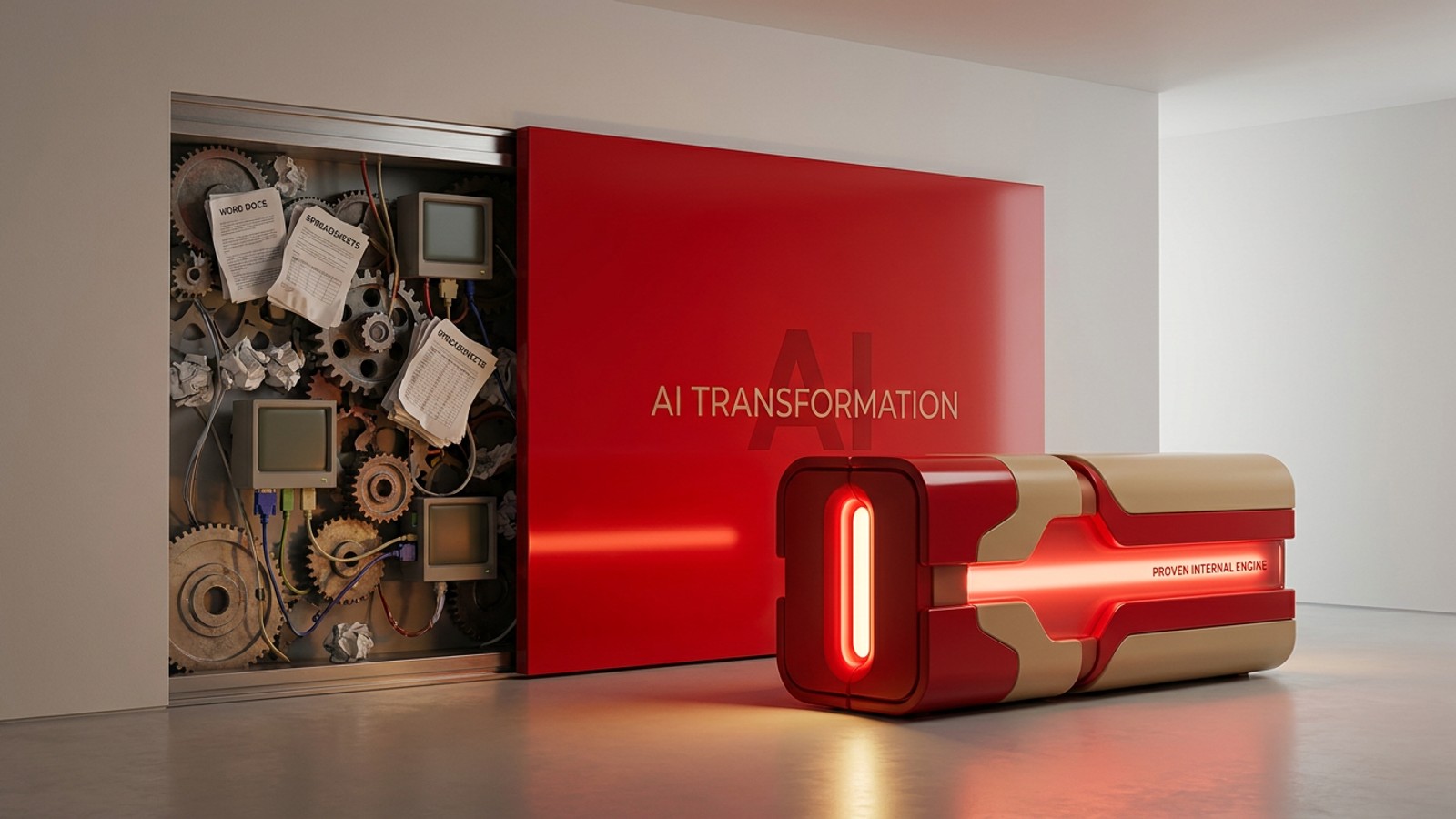
You are on a call with an AI consultancy. They walk you through a polished roadmap: agents, automation, decision intelligence. Then they share the proposal. It arrives as a Word document. Their project tracker is a spreadsheet. Their CRM is a collection of notes and memory.
This is the quiet crisis in tech consulting right now. The gap between what firms promise and how they actually operate has become impossible to ignore. You sense it immediately: if they have not unified their own operations with AI, how will they unify yours?
The ERP Lesson We Should Not Repeat
Twenty years ago, companies faced a similar choice. ERP systems promised integrated operations. Firms waited for perfect implementation, custom configuration, complete data migration. Years passed. Competitors who started imperfectly with unified systems pulled ahead while the waiters were still in planning.
The same pattern is repeating with AI infrastructure. Leaders know they need unified systems, governance frameworks, and actual AI assistance in daily work. But they are being sold fragmented tools dressed as strategy, or roadmaps that never become running code.
The cost of waiting is rising fast. Every month without unified operations means more context lost in handoffs, more manual work that should be automated, more hiring to manage complexity that systems should handle.
What a Real Business Operating System Looks Like
ElevAIte Business OS is not another SaaS tool added to your stack. It is one operating layer that unifies revenue, delivery, finance, people, knowledge and responsible AI in a single system.
Most platforms treat AI as a feature bolted onto existing modules. Business OS was built with AI as structural: context flows automatically, connections form between functions, and workflows improve themselves based on outcomes.
The architecture has three visible layers:
Context layer: Every client, project, decision and conversation exists in a shared memory the system can access and reason across.
Connections layer: Revenue talks to delivery, delivery talks to finance, finance talks to resourcing, all without manual handoffs.
Workflows layer: Processes run with AI assistance appropriate to each role, not generic automation applied blindly.
AI Governance Built In, Not Bolted On
Responsible AI cannot be an afterthought. Business OS includes AI governance at the foundation: audit trails for every AI action, role-based access controls, and clear accountability for outcomes.
The True AI Trainer system is central to this. Each role receives AI assistance calibrated to their authority and expertise. A junior analyst sees different suggestions than a department head. An SOP-based access framework means the AI copilot supports users appropriately: suggesting next steps, surfacing relevant context, flagging risks, but never overstepping defined boundaries.
This matters because most AI deployments fail on adoption. Users distrust black-box suggestions or find them irrelevant. Role-level assistance means the AI earns trust by being genuinely useful to each person, not impressive in demo and frustrating in practice.
Built Internally First, Proven Before Promotion
Here is how ElevAIte is different from the firms pitching what they have not lived. We built Business OS to run our own company first. Every feature was stress-tested on our own revenue, delivery, and hiring decisions before reaching any client.
Only when the system created measurable value internally did we begin offering it externally. This is the opposite of the consultancy model: sell the roadmap, figure out delivery later.
The ElevAIte difference: We do not sell AI transformation as theatre. We deploy systems we have already proven on our own operations, with governance and role-level assistance that makes adoption real.
Who Business OS Is For
Business OS fits service firms with 15 to 150 people who have outgrown their current stack. The symptoms are familiar: six tools that do not talk, client knowledge in individual heads, every hire reinventing process, and a growing suspicion that AI vendors are selling slides not systems.
It is particularly valuable for firms planning to buy AI consulting, who want to verify that their vendor has actually operationalised what they pitch. The question to ask any prospective partner: what system do you use to run your own firm? If the answer involves manual documents and fragmented tools, the gap between promise and delivery will be yours to close.
Your Next Step
Business OS is not a product you evaluate from a brochure. It is infrastructure we assess against your specific stage, constraints, and readiness. Some firms need the full operating layer immediately. Others need targeted automation that connects to existing systems first.
The right starting point is a conversation about your actual operations, not a generic demo.
We will review your current stack, identify where unified AI infrastructure creates value, and recommend whether Business OS or a lighter entry point makes sense. No roadmap theatre. Just a clear view of what is possible when AI runs as an operating system, not a slide deck promise.
Share this article